Ukrainian Farmers Track Regenerative Agriculture: Making Soil Health Visible
Digital MRV AI Soil Health Carbon
Project Type: Regenerative Agriculture Transition | Agricultural Land Management Carbon Credits
Location: Multiple regions across Ukraine
Methodology: VM0042
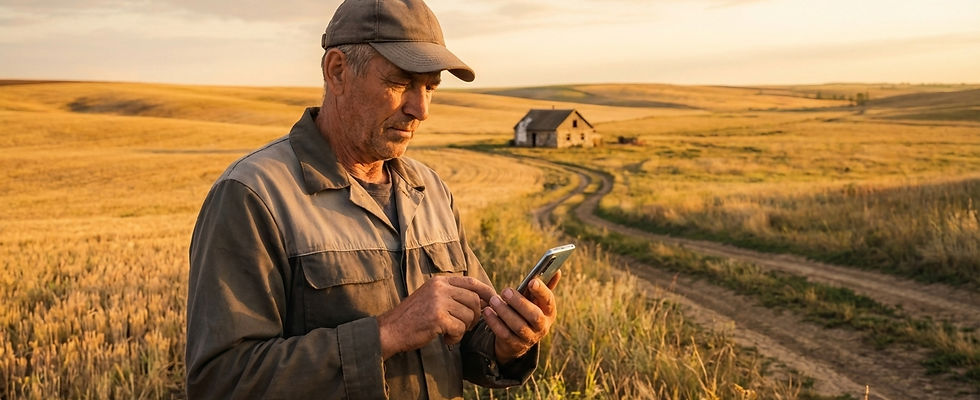
When Half a Million Hectares Need to Change How They Farm
Ukraine's agricultural landscape stretches across some of the world's most fertile soil—the famous black earth, or chornozem, that once made the country the breadbasket of Europe. But decades of industrial agriculture, heavy chemical inputs, intensive tillage, and monoculture cropping have degraded even this rich soil. Carbon content drops. Structure deteriorates. Water retention fails. The land that fed millions becomes less productive each year.
Five hundred thousand hectares of Ukrainian farmland—an area larger than the entire agricultural region of many European countries—is attempting a transition. From conventional industrial methods to regenerative practices that rebuild soil health, sequester carbon, increase resilience to climate change. The project aims to reduce greenhouse gas emissions by an average of 1,242,240 tonnes of CO₂ equivalent annually over a twenty-year period from 2025 to 2045.
This is the first agricultural carbon project entirely developed and managed by a Ukrainian team. Not an international organisation parachuting in with templates designed elsewhere. Ukrainian agronomists, soil scientists from the National University of Life and Environmental Sciences of Ukraine, and the team working directly with farmers who know their land intimately but need support transitioning to practices that are economically viable whilst also rebuilding ecosystems.
The challenge isn't convincing farmers that soil health matters—they see degradation in their yields, their costs, their vulnerability to drought. The challenge is proving to carbon credit verifiers and agricultural buyers that regenerative practices are actually happening. That organic fertilisers are being applied. That cover crops are being planted. That tillage is being reduced. That natural vegetation is being preserved at field edges.
Traditional monitoring for agricultural carbon projects is expensive and extractive. Consultants visit periodically, interview farmers, take samples, write reports. Farmers have no ownership of the data. Verification bodies see snapshots, not continuous records. Buyers question whether practices are sustained between audits.
The alternative: give farmers tools to document their own transition, in their own language, through technology that works in their reality.

Education First: Understanding Why Regenerative Agriculture Actually Matters
Before farmers started recording practices or uploading field photos, they needed to understand what they were transitioning toward and why it mattered beyond just carbon credits.
The education wasn't abstract climate science. It was practical agronomy rooted in Ukrainian soil conditions, crop systems, and economic realities.
Soil health as foundation. Farmers learned how decades of heavy tillage, chemical fertiliser dependency, and monoculture had degraded soil structure, reduced organic matter, killed beneficial microorganisms, and decreased the land's capacity to hold water and nutrients. They understood that regenerative practices weren't just environmental—they were economic. Healthier soil means lower input costs, better drought resilience, more stable yields.
Carbon sequestration as economic opportunity. The project explained how transitioning to regenerative practices—adding organic matter through compost and manure, planting cover crops, reducing tillage, preserving natural vegetation—sequesters atmospheric carbon in soil. And how verified carbon sequestration creates revenue through carbon credits that supplement farm income during the transition period when yields might temporarily dip.
Regenerative practices adapted to Ukrainian conditions. The National University of Life and Environmental Sciences of Ukraine provided region-specific guidance. Which cover crop species work in different Ukrainian climate zones. How to source organic fertilisers locally. What crop rotations build soil whilst maintaining economic viability. Traditional Ukrainian agricultural knowledge—crop diversity, integration of livestock, seasonal fallow patterns—integrated with modern regenerative approaches.
Economic sustainability during transition. Farmers learned about the support programme: consultations on transitioning specific fields, training on regenerative techniques, technical assistance when problems arose. The carbon credit revenue wasn't the only support—there was genuine agronomic partnership.
Why documentation matters. Perhaps most critically, farmers understood that carbon credits require verification. That their transition only generates revenue if they can prove practices are happening. That documentation isn't bureaucratic box-ticking—it's the evidence that makes regenerative agriculture financially viable.
After completing education modules, farmers understood they weren't just participants in someone else's carbon project. They were leading a transition that would improve their soil, reduce their costs, increase their climate resilience, and generate income through verified carbon sequestration. The documentation was how they proved it was working.

The Surveys: Making Farm Practices Visible
The survey system was designed through collaboration with farmers, agronomists, and carbon verification experts. It needed to capture what VM0042 methodology required whilst being practical enough that busy farmers would actually use it.
Core Agricultural Practices Survey
What crops do you grow? - Multiple selection in Ukrainian:
-
Кукурудза (Corn)
-
Квасоля (Beans)
-
Тыква (Pumpkin)
-
Чилі/перець (Chili/pepper)
-
Помідори (Tomatoes)
-
Цибуля (Onions)
-
Other (specify)
This wasn't just crop inventory. It tracked diversification—a key regenerative practice. Farmers moving from monoculture corn to diverse rotations could document the change over seasons. Crop diversity appears in carbon credit calculations because different crops contribute different amounts of organic matter, have different root structures that affect soil carbon, require different inputs.
Type of farming - Multiple choice:
-
Богарне/дощове (Rainfed/rainfall dependent)
-
Зрошуване (Irrigated)
-
Змішане (Mixed)
-
Other (specify)
Water management affects carbon accounting. Irrigated systems have different emissions profiles than rainfed. The methodology needs to know which practices apply to which land management type. And as climate change affects Ukrainian rainfall patterns, tracking irrigation changes over the project period matters.
What fertilisation methods do you use? - Multiple selection:
-
Органічний компост (Organic compost)
-
Тваринний гній (Animal manure)
-
Хімічні добрива (Chemical fertilisers)
-
Зелені добрива/покривні культури (Green manures/cover crops)
-
Other (specify)
This is where regenerative transition becomes measurable. Baseline conventional farming relies heavily on chemical fertilisers. Regenerative approaches shift toward organic compost, animal manure, and green manures that build soil organic matter whilst providing nutrients. Farmers could document the transition year by year—percentage of fields using organic versus chemical, amounts applied, timing of application.
Cover crops deserve special mention. Planting species like clover, vetch, or rye between cash crops adds nitrogen naturally, prevents soil erosion, builds organic matter, suppresses weeds, and sequesters significant carbon. Ukrainian farmers traditionally used some cover cropping, but industrial agriculture had largely abandoned it. The regenerative transition brought it back—and the survey documented adoption rates across the 500,000 hectares.
How do you conserve water? - Open text field
Water conservation practices vary enormously by region, soil type, and crop system. Open-ended questions let farmers describe what they're actually doing: mulching to reduce evaporation, contour plowing to slow runoff, cover crops that improve soil water retention, traditional techniques passed down through generations. Narrative responses captured local innovation that multiple-choice questions would miss.
Do you leave natural vegetation at field edges? - Yes/No
Preserving natural vegetation along field boundaries provides biodiversity habitat, reduces erosion, creates windbreaks, and sequesters carbon in perennial plants and their root systems. It's also something satellite imagery can verify—connecting farmer-reported practices with remote sensing validation. When farmers said yes, verification bodies could check.
Are you interested in organic farming? - Open text
This looked forward. Some farmers were transitioning toward full organic certification, which requires years of verified chemical-free management. Others were adopting regenerative practices but not pursuing organic certification. Understanding farmer intentions helped project managers provide appropriate support and helped carbon credit buyers understand the trajectory of the land management transition.
Photos and Videos Upload - Three options:
-
Зробити фото (Take Photo) - immediate documentation
-
З галереї (From Gallery) - upload previously captured images
-
Вибрати відео (Select Video) - video evidence of practices
Visual documentation was critical. Photos of compost piles being prepared. Videos of cover crop establishment. Images showing reduced tillage equipment or natural vegetation at field edges. GPS-tagged photos with timestamps created verifiable evidence that practices were happening when and where farmers reported.
The note "Files will be uploaded when submitted" reflected offline functionality—farmers could complete surveys in fields without mobile coverage, take photos, then upload everything when back in range.


Activity Documentation: The Transparency That Makes Carbon Credits Possible
Beyond periodic surveys, farmers could record ongoing activities through the app. This continuous documentation created the transparency that verification bodies and agricultural off-takers needed.
When did you apply organic fertiliser? Record the date, field location, type of fertiliser, amount applied. Over months and years, this builds a complete picture of soil amendment practices. Verification bodies don't just see "farmer says they use compost"—they see timestamped records of specific applications with GPS coordinates showing which fields.
Where did you plant cover crops? Map the fields, note the species planted, record establishment dates. When those cover crops are terminated and incorporated into soil (adding organic matter and carbon), record that too. The complete cycle documented by the person doing the work.
What tillage did you perform? Note whether it was conventional deep tillage or reduced/no-till approaches. Record equipment used, depth, timing. Reduced tillage is a cornerstone regenerative practice—less soil disturbance means less carbon released to atmosphere, better soil structure, lower fuel costs. But verification requires proof it's actually happening.
Intercropping patterns? Document which crops are grown together, spatial arrangements, timing. Intercropping—growing complementary crops in the same field—increases diversity, improves pest management, enhances soil health. Traditional Ukrainian agriculture used intercropping extensively. Modern regenerative approaches revive and refine these practices.
All this documentation flowed through farmers' phones to a platform accessible to project managers and verification bodies. Not replacing field visits and soil sampling—those still happened—but providing continuous evidence between formal audits. When verifiers arrived, they reviewed months of farmer-documented practices, then sampled and tested to confirm.
For agricultural off-takers—companies buying grain or other crops from project participants—the transparency mattered too. Increasingly, food companies want to source from regeneratively managed land. The documented practices provided evidence their supply chains were genuinely transitioning.
AI Crop Health Monitoring: Satellite Alternatives for Farms That Can't Afford Them
Satellite imagery and expensive monitoring equipment aren't accessible to most Ukrainian farmers. Even if they were, satellites can't see everything—cloud cover obscures images, resolution isn't always sufficient for small fields, interpretation requires expertise most farmers don't have.
The AI crop health monitoring through the app provided an alternative. Farmers photographed crops at regular intervals. AI analysed the images for health indicators—colour suggesting nitrogen status, growth patterns, stress signs, pest or disease symptoms.
This wasn't replacing agronomic expertise—it was augmenting it. When AI flagged potential problems, farmers investigated. Sometimes the issue was real and needed intervention. Sometimes it was a false alarm. Over time, the AI improved as it learned from Ukrainian crop systems, soil types, and climate patterns.
The crop health data fed into project monitoring in several ways:
Verification of practice effectiveness. If farmers transitioned to regenerative practices and crop health improved over time, that suggested the practices were working. Declining health might indicate problems with transition techniques, pest pressure, or climate stress requiring additional support.
Early problem detection. Catching crop stress early—before it's visible to casual observation—let farmers intervene when solutions are cheaper and more effective. Regenerative agriculture requires active management during transition. AI-assisted monitoring helped farmers manage that complexity.
Evidence of sustainable productivity. Carbon projects sometimes face criticism that they reduce food production. Documented crop health over years showed that regenerative Ukrainian farms maintained productivity whilst sequestering carbon and improving soil. That mattered for policy support, farmer adoption, and buyer confidence.
Accessibility. A farmer with a smartphone could monitor crop health. No satellite subscriptions, no expensive sensors, no external consultants required for routine monitoring. The technology adapted to Ukrainian farming reality.
What the Documentation Revealed
As farmers across 500,000 hectares uploaded surveys and activity records over the growing seasons, patterns emerged that guided project implementation.
Transition wasn't uniform. Some regions showed rapid adoption of cover cropping—farmers saw neighbours succeed and followed quickly. Other areas were more cautious, trying practices on small field sections before scaling up. The data showed where additional training and demonstration sites would accelerate adoption.
Organic fertiliser access varied regionally. Areas with significant livestock operations had ready access to manure. Grain-focused regions without animals struggled to source organic amendments economically. This revealed the need for composting training and equipment—helping farmers turn crop residues into organic fertiliser rather than relying on external sources.
Water conservation practices drew on traditional knowledge. Older farmers described techniques their grandparents used before industrial agriculture. Younger farmers learned from these narratives and adapted them with modern understanding. The open-text survey responses captured knowledge that might otherwise have been lost.
Natural vegetation preservation faced economic pressure. Farmers understood the ecological value of field-edge vegetation, but some faced pressure from neighbours or village governance to maximize cultivated area. The yes/no question on vegetation preservation showed which communities needed dialogue about balancing production with ecosystem services.
Photo documentation caught implementation problems early. When farmers uploaded photos of cover crop establishment, agronomists sometimes spotted issues—planting too shallow, wrong species for soil type, timing problems. Quick feedback prevented failures that might have discouraged adoption.
Crop diversity increased measurably. Baseline data showed heavy monoculture. Multi-year surveys documented farmers adding legumes to rotations, trying diverse vegetables, intercropping complementary species. The percentage of farms growing three or more crops increased significantly in project's early years.
AI crop health identified regional stress patterns. Certain areas showed consistent stress indicators during particular growth stages. Investigation revealed it wasn't farm management problems—it was soil characteristics requiring specific amendments or crop varieties better suited to those conditions. Regional adaptation of regenerative practices improved based on what AI monitoring revealed.

How This Changed Agricultural Practice and Carbon Verification
The documentation didn't just record changes—it enabled them.
Farmers became agronomic record-keepers. Previously, farmers remembered what they'd done or kept informal notes. Now they had systematic records of every fertiliser application, tillage event, cover crop planting. When something worked well, they could review exactly what they'd done and replicate it. When yields disappointed, they could analyse practices to understand why.
Peer learning accelerated. Project managers could (with farmer permission) share anonymised success stories. "A farm in your region increased soil organic matter by X% using these specific practices—here's their documented approach." Evidence-based peer learning spread innovations faster than top-down training.
Carbon verification became continuous. Traditional agricultural carbon projects verify practices periodically—auditors visit, review records, sample soil, assess practices, and leave. Until the next audit, there's limited oversight. This project provided verification bodies with continuous data streams. Quarterly reviews of documented practices caught issues early rather than discovering problems a year later.
Economic value became visible. Farmers could show buyers exactly how their crops were grown. "This grain came from fields where we applied X amount of compost in month Y, planted cover crop Z, reduced tillage by this amount." Premiums for regeneratively grown products require proof—the documentation provided it.
Technical support targeted actual needs. When the team consultations helped farmers, they focused on real problems visible in the data. Not generic advice, but "your crop health photos suggest nitrogen deficiency in this field—let's discuss green manure options" or "your cover crop timing in that zone seems late based on other regional data—try this window instead."
Soil improvement became measurable. Periodic soil sampling showed carbon content changes. Linking those measurements to documented practices revealed which approaches worked best in Ukrainian conditions. Cover crops plus compost showed stronger carbon increase than either alone. Reduced tillage protected carbon gains. Evidence accumulated that could guide national agricultural policy.
Climate resilience showed in documented responses. When drought hit certain regions, farmers with documented water conservation practices and improved soil organic matter (which holds moisture) showed better crop health in AI monitoring. When heavy rains caused erosion, farmers with documented cover cropping and natural vegetation showed less soil loss. The resilience benefits of regenerative agriculture became visible in real-time data, not theoretical claims.
The Piece Most Agricultural Carbon Projects Miss: Farmer Ownership
Large-scale agricultural carbon projects typically treat farmers as participants implementing someone else's plan. External experts design the interventions, external consultants monitor implementation, external verifiers assess results. Farmers provide land and labour. Maybe they get training. Hopefully they get carbon revenue share. But they don't own the process.
This project worked differently because it was designed by Ukrainians for Ukrainian farmers with Ukrainian agronomic expertise.
The National University of Life and Environmental Sciences of Ukraine wasn't brought in for credibility—it was a core partner from the beginning, ensuring practices suited Ukrainian soils, climate, crop systems, and farming culture. The team provided ongoing support, not periodic check-ins. And critically, the documentation tools put knowledge generation in farmers' hands.
When a farmer recorded that applying compost in early spring worked better than fall application for their soil type, that became part of project knowledge. When crop health monitoring revealed regional patterns, farmers saw the data and participated in interpreting it. When activity documentation showed which practices were spreading fastest, farmers understood what their neighbours were finding successful.
This ownership mattered for several reasons:
Transition persistence. Regenerative agriculture is harder than conventional in the short term—more knowledge-intensive, more management required, temporary yield dips possible. Farmers stick with difficult transitions when they understand why they're doing it, see evidence it's working, and feel ownership of the process. Documentation that shows their own soil improving, their own crop health responding to practices, their own carbon sequestration verified—that sustains commitment through challenges.
Knowledge retention. When external consultants do all the monitoring, knowledge leaves with them. When farmers document their own practices and results, knowledge stays on the land. The next generation inherits not just soil but records of what worked, what failed, what their specific fields need.
Economic empowerment. Farmers who can document their practices control their market narrative. They're not dependent on third parties to certify their regenerative methods. They have evidence they can show buyers, verifiers, lenders, anyone who questions whether their practices are genuinely regenerative.
Resilience to disruption. Ukraine knows disruption. Even during the project design period, the agricultural sector faced immense challenges. Farmers with documented practices, digital records, and ownership of their data are more resilient. If physical records are lost, digital backups remain. If consultants can't visit due to conflict or logistics, farmers continue monitoring. The system is decentralized and robust.

What's Coming: Full-Spectrum Agricultural Monitoring
The initial surveys and activity documentation established foundations. The platform's capabilities will expand based on farmer feedback and verification requirements.
Biodiversity monitoring integration. Regenerative agriculture should increase farmland biodiversity—more beneficial insects, birds, soil organisms. Adding species observation surveys (similar to the Mexican biodiversity project) would document these co-benefits. Farmers already notice wildlife returning to fields with cover crops and natural vegetation. Systematic documentation would prove it.
Soil health indicators beyond carbon. Carbon sequestration is what generates credits, but regenerative agriculture improves many soil properties—water infiltration, nutrient cycling, biological activity. Farmers could document simple soil health tests (penetration resistance, earthworm counts, aggregate stability) that are easy to perform and meaningful for management.
Equipment and input tracking. Document precisely which equipment is used for reduced tillage, where organic fertilisers are sourced, what cover crop seeds are planted. This enhances verification and helps farmers optimize their supply chains and equipment investments.
Weather and climate integration. Connecting farmer observations with local weather data helps interpret crop health patterns, understand water conservation effectiveness, and demonstrate climate resilience benefits of regenerative practices.
Marketplace integration. Direct connection between documented practices and buyers seeking regeneratively grown products. Farmers who can prove their methods connect with markets willing to pay premiums. The documentation becomes a marketing asset.
Offline AI agricultural advice. Expanding beyond crop health monitoring to provide farmers with AI-assisted agronomic advice that works without internet. Questions about cover crop selection, pest management, soil amendment timing—answered based on project knowledge accumulated from thousands of Ukrainian farms.
Why This Matters Beyond Carbon Credits
Five hundred thousand hectares is substantial, but it's a fraction of Ukraine's agricultural land. The significance isn't just the carbon sequestered or the soil improved on project farms. It's the model demonstrated.
Ukrainian farmers can lead agricultural transition when given appropriate support. Technology can enhance farmer agency rather than replacing it. Documentation can empower rather than burden. Carbon credits can fund regenerative transition in ways that benefit farmers, soil, climate, and food systems simultaneously.
The project shows verification doesn't require expensive external monitoring—it requires giving farmers tools to document their own practices in formats that meet verification standards. It shows regenerative agriculture isn't just for small organic farms in wealthy countries—it works at scale in large agricultural economies when economic support (carbon credits) and technical support (university partnership, training, responsive consultations) align.
And critically for Ukraine specifically, it shows Ukrainian agricultural expertise can lead climate solutions. International carbon finance needs Ukrainian know-how, not the reverse. The black earth that once made Ukraine the breadbasket of Europe can become a carbon sink that helps stabilize global climate—whilst producing food more sustainably and building rural economic resilience.
When those 500,000 hectares show measurably improved soil health, verified carbon sequestration, maintained productivity, and farmer economic sustainability, the model scales. Other Ukrainian regions adopt it. Other countries facing similar agricultural degradation adapt it. The documented evidence—thousands of farmers recording millions of practices over years—becomes proof that regenerative agriculture works economically and ecologically at the scale climate change requires.
That's what happens when you give farmers ownership of monitoring, recognize their knowledge, support their transition, and build technology that serves their reality. The soil heals. Carbon returns to where it belongs. Farmers thrive. And the documentation that makes it verifiable becomes the foundation for agricultural transformation that extends far beyond one project's boundaries.
The tools exist. The agronomic knowledge exists. The farmers who know their land exist. What was missing was connecting them in ways that generated both ecological recovery and economic viability. That's what this project demonstrated. And the documented evidence—accumulated through phones in farmers' hands across half a million hectares—proves it's possible.
Your Project
Could Work Like This
If you're working on a climate or environmental project that needs verified community data, you're probably facing similar questions to the ones in this case study.
How do you prove your project is working beyond just the technical metrics? What data do your funders need for carbon credits or ESG reporting? How do you catch problems on the ground before they undermine your results? Most importantly—how do you ensure the people affected by your project actually understand and benefit from it?
The difference between projects that succeed and ones that struggle often comes down to whether you're measuring the right things. Carbon calculations tell you about emissions. Community feedback tells you whether the intervention is actually working in practice. Education ensures that feedback is informed, not just reactive.
We've built the survey systems, education modules, and geotagged monitoring tools that made this project work. The same approach adapts to your context—different activities, different locations, different communities, different objectives.
What you get:
-
Custom education modules that teach participants about what they're monitoring and why it matters
-
Multilingual surveys designed for offline use in areas with limited connectivity
-
GPS-tagged responses that show location-specific patterns and problems
-
Anonymous feedback systems that protect privacy whilst collecting honest data
-
Verified data packages that meet carbon credit, MRV, and ESG reporting requirements
-
Operational insights that help you fix problems before they become failures
What your project needs:
-
A climate, environmental, or development initiative (planning stage or already operating)
-
Community members whose participation and feedback would strengthen your project
-
Funders or stakeholders who want proof of impact alongside technical metrics
The platform works whether you're monitoring 10 hectares or 10,000, whether you're in a remote village or an urban centre, whether your participants speak Spanish, English, French, Hindi, Indonesian, or Ukrainian.
Get Started
If you're working on a project that needs more than just technical data—where community engagement and verified feedback actually matter—let's talk about how this approach could work for you.
Or if you're not sure whether this approach fits your situation, send us a quick message describing what you're trying to achieve. We'll tell you honestly whether education-based community monitoring makes sense for your context.
Email us: nick@citizenclimate.net